Why Yummy Is the Handwritten Font Your Design Toolkit Needs
There is something about handwritten fonts that feels immediately disarming. In a world saturated with polished sans-serif typefaces and rigid geometric forms, a font that mimics natural handwriting can cut through the noise with remarkable ease. Yummy is one such typeface. As the name suggests, it brings a certain warmth and approachability to any project. But beyond its charming appearance, Yummy is a simple handwritten font that offers surprising versatility across a wide range of applications. Whether you are designing a wedding invitation, crafting a social media campaign, or laying out a product label, Yummy has the potential to elevate your work without overwhelming it.
Hand-drawn typography has seen a resurgence in recent years, partly driven by the desire for authenticity in digital spaces. Brands and creators alike are looking for ways to feel more human, more tactile, and more relatable. Yummy fits squarely into this movement. It is not a font that tries to be everything to everyone. Instead, it does one thing well: it brings a simple, natural feel to text while remaining highly readable. That combination is harder to find than most people realize.
The Anatomy of Yummy: What Makes It Unique
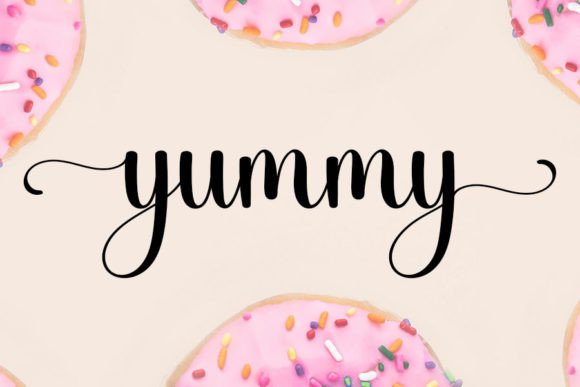
To understand why Yummy stands out among handwritten fonts, it helps to look at its design characteristics. The letterforms are clean without being sterile. Each character carries a slight irregularity that mimics the natural pressure and flow of a pen on paper. The strokes are not perfectly uniform, and that is precisely the point. This imperfection is what gives Yummy its organic quality.
The x-height is generous, which improves legibility even at smaller sizes. Descenders and ascenders are balanced, allowing the font to sit comfortably in body text contexts without looking cramped or chaotic. The baseline is steady but not rigid, which helps maintain a handwritten feel while keeping the overall composition readable. Yummy also includes a good range of ligatures and alternate characters, giving designers room to customize the look and avoid the repetitive feel that can plague some handwritten fonts.
Another notable quality is the weight distribution. The font avoids being too thin or too thick, which makes it suitable for both digital screens and print. It holds up well on retina displays, yet retains its texture when printed on uncoated paper. This dual adaptability is not something every handwritten font can claim.
Where Yummy Shines: Practical Applications Across Projects
The true test of any typeface is how well it performs in real-world scenarios. Yummy excels in several key areas, which is why it has become a go-to choice for designers working across different media. Below are some of the most effective use cases for this font.
Greeting Cards and Stationery
This is perhaps the most intuitive application. Greeting cards rely heavily on emotional resonance, and a handwritten font can convey sincerity in a way that standard typefaces often cannot. Yummy works beautifully for birthday cards, thank-you notes, and holiday greetings. Its natural flow makes the text feel personal, as if each word was written by hand. Paired with a simple illustration or a soft color palette, the font creates a warm and inviting composition. For stationery sets, Yummy can be used for both the main message and supplementary text like dates or return addresses, provided the size is adjusted appropriately.
Headlines and Display Text
Despite its simplicity, Yummy has enough presence to hold its own in headline settings. When scaled up, the stroke details become more pronounced, and the slight irregularities add visual interest. It works particularly well for blog headers, magazine titles, and social media graphics. The key is to give it room to breathe. Ample letter spacing and generous margins help the font maintain its charm without feeling cluttered. In contexts where you want to evoke warmth or approachability, Yummy can outperform many display fonts that rely on boldness or novelty to grab attention.
Product Labels and Packaging
Packaging design is another area where Yummy excels. Handwritten fonts are often used to convey artisanal quality or small-batch authenticity. A jar of honey, a box of handmade chocolates, or a bottle of craft soda can all benefit from the natural feel that Yummy brings. The font works well as the primary brand name on a label, but it also functions effectively for ingredient lists or short descriptive copy. When combined with a clean layout and natural textures like kraft paper or matte finishes, Yummy helps the product feel approachable and carefully made.
Wedding and Event Invitations
Event invitations require a delicate balance between elegance and personality. Yummy strikes this balance well. It is refined enough to feel special, yet relaxed enough to avoid stiffness. For wedding invitations, it can be used for the couple's names, the date, or even the entire body of text if kept at a reasonable size. The font pairs nicely with script typefaces or serif fonts for contrast. Many designers find that Yummy reduces the need for extensive ornamentation because the type itself carries enough character to carry the design.
Digital Content and Social Media
In the digital space, handwritten fonts are often used to add a human touch to otherwise polished content. Yummy works well for Instagram quotes, Pinterest pins, and YouTube thumbnail text. It also performs nicely in email newsletters where you want the header to feel personal. The font is legible enough at medium sizes to work on mobile screens, which is critical for social media consumption. One practical recommendation is to use Yummy for short, impactful phrases rather than long paragraphs in digital contexts, as extended reading can become tiring in any handwritten style.
How Yummy Fits Into Modern Design Workflows
Integrating Yummy into your workflow is straightforward, but there are a few considerations that can help you get the most out of it. The font is available in standard formats such as OTF and TTF, making it compatible with major design software including Adobe Creative Suite, Figma, Canva, and Affinity Designer. It also works well in web design through @font-face embedding or services like Adobe Fonts, depending on how it is licensed.
One of the practical advantages of Yummy is that it does not require extensive kerning adjustments. The spacing is well-tuned out of the box, which saves time during the layout phase. However, for headlines or display use, slight manual tracking adjustments can enhance readability and visual balance. If you are using Yummy in a multi-font layout, it pairs well with minimalist sans-serifs like Montserrat or Lato, as well as with classic serifs such as Garamond or Georgia. The contrast between a structured sans-serif body and Yummy's handwritten headlines creates a dynamic but harmonious hierarchy.
For designers working on branding projects, Yummy can serve as the signature typeface for businesses that want to project a friendly, approachable identity. Coffee shops, bakeries, children's brands, and lifestyle bloggers are all good candidates. The font's simplicity ensures it does not overshadow other brand elements, while still providing enough personality to be memorable.
Considerations Before Choosing Yummy
No typeface is perfect for every situation, and Yummy is no exception. Understanding its limitations helps you use it more effectively. Because it is a handwritten font, it is not ideal for lengthy body text in print or on screen. Extended reading can lead to eye strain, and the informal nature of the font may undermine the authority of longer content. Save Yummy for short passages, headlines, or accent text where its personality can shine without overwhelming the reader.
Another factor to consider is context. Yummy is warm and casual, which means it may not suit formal or highly corporate projects. A legal document, a financial report, or a luxury brand identity would likely require a more restrained typeface. That said, Yummy can work in professional contexts where approachability is an asset, such as in internal communications, team newsletters, or community-oriented branding.
Language support is another practical consideration. Yummy includes standard Latin characters and common punctuation, but it may not cover extended character sets for Central European, Cyrillic, or other non-Latin scripts. If your project requires multilingual support, it is worth checking the font's character set before committing to it.
Pairing Yummy With Other Design Elements
To get the best results from Yummy, consider the visual environment around the text. The font thrives in layouts that embrace negative space. Crowding it with too many competing elements diminishes its natural charm. Soft color palettes, natural textures, and simple illustrations all complement Yummy well. Avoid pairing it with overly decorative borders or busy backgrounds, as the font's subtlety can get lost.
When it comes to color, Yummy works beautifully in dark shades like charcoal, deep navy, or rich brown against light backgrounds. For a more playful look, pastel tones or muted earthy colors can reinforce the friendly tone of the font. Gradient fills or textured lettering can also work, but should be used sparingly to maintain readability.
Photography is another element that pairs naturally with Yummy. Lifestyle images, food photography, and candid portraits all align with the font's casual authenticity. The combination of a handwritten headline over a warm photograph often creates the kind of emotional resonance that brands and creators are seeking.
Why Designers Keep Coming Back to Yummy
Trends in typography come and go, but certain fonts endure because they fulfill a fundamental need. Yummy has earned its place in many designers' toolkits because it solves a recurring problem: how to communicate warmth without sacrificing clarity. In a landscape where audiences are increasingly skeptical of overly polished marketing, handwritten fonts like Yummy offer a way to connect on a more human level.
The font's simplicity is its greatest strength. It does not try to reinvent typography or push boundaries. Instead, it does what a good handwritten font should do: it looks like it was made by a person, not a machine. That distinction matters more now than ever. Whether you are designing a greeting card, a product label, a wedding invitation, or a social media graphic, Yummy gives you a reliable way to add a simple, natural feel to your next project. And sometimes, that is exactly what a design needs.
If you have not yet tried Yummy in your work, it is worth experimenting with. Start with a small project, perhaps a single greeting card or a social media post, and see how the font changes the tone of the piece. You might find that something as simple as a typeface can make all the difference.